Reflections and essays grounded in long-term Zen practice, training, and ordinary life.
August 5, 2026
Compassion Is Not Pity: A Lesson From Kansei-san
- excerpt from ‘A Guided Course in Zen Meditation‘
I had the honour of being the attendant to the Kansei-san (the retired Abbot of Sogenji Monastery) for a period of time. He was an old man and his health was such that we had a constant live-in attendant with him at almost all times.
He enjoyed his peace and quiet so it surprised me one day when he invited a pair of guests in for a chat. They were hospice workers from the United States of America who were visiting the monastery as guests of the Roshi to speak with us about the work they did. The guests were suitably awed by the invite and once they were settled the Kansei-san asked (through me), “What is it you want to ask me?”
This again took us all by surprise but immediately one of them spoke up. As a hospice worker his job was to ease the pain and suffering of the dying process yet he was amazed that so many of his patients were angry with him or treated him poorly. He couldn’t understand how people who were dying could be upset at him as he tried to make things easier for them. This was obviously a very heart-felt question for him and we were all moved by it.
The Kansei-san said, “Look at me, I am old, I am sick, I am suffering.” He then patted me on the head as I knelt by his chair, “Look at this young monk, he is also suffering, even though he is not sick in the body he has doubts and fears and pain – this is the source of his suffering. Both of you before me are suffering too; emotionally, physically or because you understand that you too will die one day without fulfilling all your dreams.
“When you go before a person who is dying how do you approach them? Do you meet them as a fellow traveller on the path of life who is suffering just as they are? Or do you meet with them as someone who is better off than them and can offer to take away their pain from this ‘better’ place. They are angry with you because you stand apart from them and that makes them feel sicker, sadder and makes their suffering even more intense.
“When you meet with someone who is suffering reach into your own being and find that place of your own suffering. Compassion is not about pity, it is about putting yourself in another’s shoes.”
July 21, 2026
What is a Nen (念)
- excerpt from ‘A Guided Course in Zen Meditation‘
Understanding Nen is an essential part in our journey to the heart of Zen.
1 NEN, 2 NEN, 3 NEN
To the Japanese the ‘Nen’ (念) is the smallest unit of time. It literally means a “moment of awareness”.
We are so used to processing vast amounts of information that we never really understand how the human mind works. We see, think and do so much all at the same time that we feel we can multitask almost anything. However, the mind does not work like this. The mind can really only do one thing at a time, it is just that it does it so fast that we have the illusion we are multitasking.
If you were to look at the streets in Sydney (especially if you were born in a less chaotic city or in the country) it seems to be that everyone is trying to shove as many cars as possible down roads that were not designed for this. When I used to drive to work in the morning I would find my main road of 3 lanes became a main road of 2 lanes and then finally a main road of 1 lane. As the roads became narrower drivers became more and more stressed since the number of cars had not changed, just the space to fit them! This is exactly how stress in the mind works too.
When we work and live at a rate we are accustomed to it is like a well-designed traffic system. Everything flows smoothly and things are resolved at a comfortable pace. When we are overwhelmed with demands of either an external or internal nature we are like those drivers who are trying to eat breakfast and navigate the car through hostile traffic whilst talking to the kids who are screaming the back seat. No wonder people (and drivers) snap… crying for it all to slow down for a moment – we are overwhelmed and just want a breather.
The question is: How do we become overwhelmed in the first place?
The Japanese word ‘nen’ illustrates the smallest unit of time available to us. It is a moment of thought or awareness. It is that instant where we see, hear, touch, taste or smell something. It is pure and unadulterated awareness before we can think about what we see, before we can conceptualise it. We cannot even describe it because it is pre-thought and thus pre-speech. We actually live like this all the time; this is the reality of the mind at work. 1 nen, a sound enters our awareness; next nen we smell something; next nen we see something.
However well pure awareness might serve the poet and artist it is no good if we cannot share it with another. To do this we have to name what we have experienced. Thus we hear a sound (1st nen) and then we name that “bird song” (2nd nen). We experience vision (1st nen) and then we name that which we see “tree” (2nd nen), and so on. To name the objects of our awareness we have had to make a sacrifice though, we sacrifice one nen of awareness to allow that time to be used for the naming of the first object, thus instead of two moments of raw experience we have one experience and one name for that experience.
Again, wandering through the world collecting experiences and naming them might be fascinating for some people but it is not going to be of much practical use for getting a report on your boss’s desk by 9am. This is why we use at least another nen to conceptualise further. It goes something like this: I see an object (1st nen) which I recognise is a “dog” (2nd nen) then a thought, a memory or an idea is born from this: “I was bitten by a dog” (3rd nen). We have used up another moment of raw experience to categorise and intellectualise that first moment of awareness from the name we have given it. 1 nen, 2 nen, 3 nen. Instead of 3 experiences we have a single experience and a line of thought; though usually we will go on and on embellishing it further with ideas about the dog’s pedigree and colour then our mind ambles off to think about the dog we wanted but could never have etc, etc… We are suddenly in a day-dream all starting from a single experience and time flows by as we become lost in our thoughts. Over the day these thoughts multiply. We take less and less in as our mind is overstocked and overfilled, our stress levels rise and we wonder why.
When we practice meditation we are paring our experiences back down towards the 1st nen by training the mind. We have the awareness of our breath entering our hara (1st nen) and then we give it a name “one” (2nd nen). There is nothing else to think about, there can be no 3rd nen possible because we catch our mind wandering and we bring it right back to the breath and “one”. We keep this going for the length of our sit; experiencing the breath fully and then letting that experience go. There is no comparison of breaths (“wow, that one was almost as good as the one I had 10 breaths ago”) and no holding onto the experience wanting it to be bigger and better. We experience fully, give it a name and do it over and over again. When we stand up from our meditation we suddenly discover that we feel calm and centred again. Sure we might still have to write that report or drive through the mad streets but we have allowed the mind to go back to what it does best, just experiencing. We have ‘done nothing’ but are now clear, calm and centred. We are ready to do the work that seemed so daunting just 30 minutes before.
May 12, 2025
What Can a 15m Buddha Teach Us About the Nature of Reality and Interconnection?
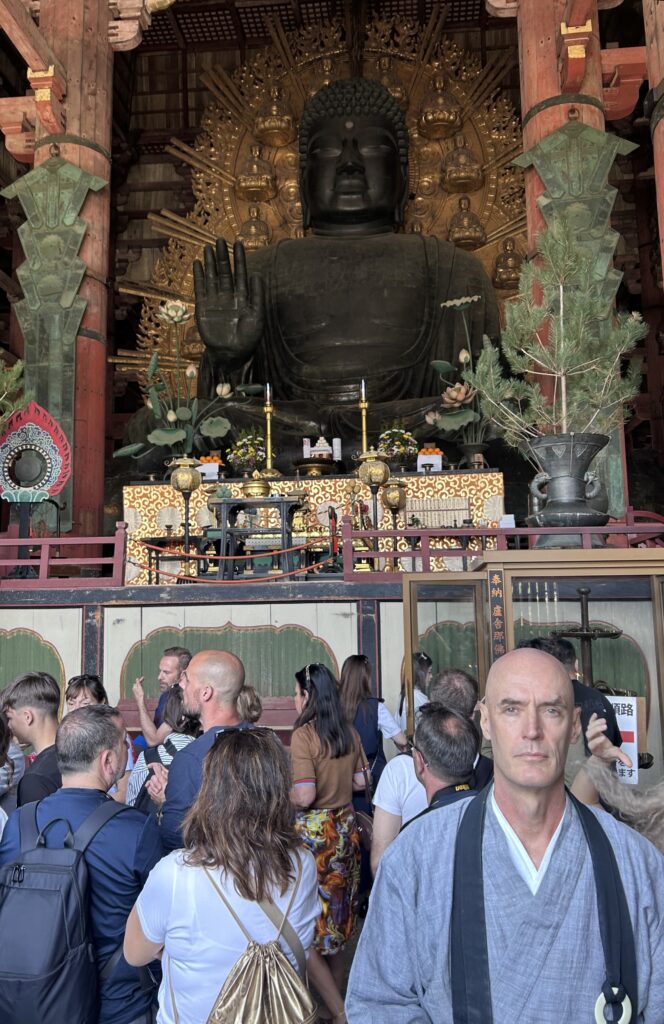
This is the Great Buddha of Tōdaiji (東大寺) in Nara, Japan. Known as Dainichi Nyorai (大日如来), it represents Vairocana Buddha within the Mahayana tradition.
In Buddhism, Vairocana does not represent a creator god or separate divine being. Rather, it points toward the inseparable and conditioned nature of existence itself.
This understanding is closely connected to the teaching of emptiness (śūnyatā), explored deeply within the Avataṃsaka Sūtra (Kegon Kyō, 華厳経). Emptiness does not mean that nothing exists. It means that nothing possesses independent, permanent, or separate existence.
Nothing stands alone.
What we call the “self” is not a fixed and isolated entity moving through the world independently. It is a temporary arising of causes and conditions: body, sensation, memory, habit, environment, relationship, perception and consciousness continually changing and interacting.
Yet we live as though this “I” is absolute.
We cling to “my” success, “my” suffering, “my” anger, “my” fear and “my” desires as though they exist independently from the rest of existence. From this attachment to self comes much of our confusion and suffering.
The image of the Buddha therefore serves as more than religious symbolism or decoration. It points back toward the conditioned and interconnected nature of existence and asks us to examine carefully the assumptions we make about who and what we are.
Whether encountered in a monastery, museum, or garden, a Buddha statue quietly asks the same question:
If there is no permanent and separate self to cling to, how then should one live?
May 9, 2024
CELIBACY
May 4, 2024 – Celibacy affords absolute clarity of mind

From a spiritual sense celibacy deserves a closer look.
Merriam-Webster defines celibacy as:
1: the state of not being married
2a: abstention from sexual intercourse
2b: abstention by vow from marriage
In a Zen monastery we are expected to practice physical celibacy but it was not until I experienced “true celibacy” that I came to understand how liberating it is.
True celibacy is that state of mind of having neither sexual awareness nor desire; one is literally unable to see anyone (male, female or the spectrum of sexuality between) as an object of desire.
In essence it is the ultimate acceptance that the cause of desire is oneself.
That is to say: YOU cannot MAKE me desire you. The desire is already within me and I consciously or unconsciously choose to manifest it through you.
I am going to work this into a larger piece on Buddhism’s Three Poisons (Ignorance, Desire and Anger) and Male Violence at another time because this is an important topic with huge ramifications for society. For now I thought I might explore some more on this question of sexuality vs true celibacy.
Buddhism is founded on the concept of The Four Noble Truths.
The Truth of Suffering – to exist is to suffer.
The Truth of the Cause of Suffering – suffering is caused by Attachment, particularly to the Three Poisons (Ignorance, Desire and Anger).
The Truth of the End of Suffering – there is a way to live without suffering, to end attachment.
The Truth of the Path that Frees us from Suffering – This is Noble Eightfold Path. If you want a Zen view of this please see my book.
When we look at sexuality we see that it is inherently based on desire, and desire is one of the Three Poisons that so easily leads to attachment and thence to suffering. This is why monastics (and not just Buddhist ones) default to physical celibacy. The energy that is sex runs almost as deep as the questing need for spiritual understanding; the difference is that it is much more easily accessed.
This is why Mumon Roshi said “The closest most people come to enlightenment is an orgasm“.
It is this dominating nature of sexual desire that is the reason why so many religions impose restrictions upon it. However even if we deny it physically what do we do with the endless thoughts and emotions that it stirs within us?
We can walk past a cake shop, see some delicious cake and yet move on. We are not carrying that cake around with us in our mind for the rest of the day. We saw something we liked, appreciated it, decided it was either unavailable to us or it was healthier for us to not partake and moved on. Within a few seconds it is forgotten.
This is not so easy to do with sexual desire. It speaks to a place deep in our core and our response to it is visceral. A stray glance is carried around all day. A random touch suddenly lights our neurons making us weak at the knees and weakening our resolve. It matters not whether we act on these things. We are already being pulled around by them and losing our way. We are attached to it. Our responses to this sort desire is a direct reflection of our integrity as a person.
To be truly celibate is to not even allow that internal desire to rise in the first place. If we wish to not impose our desire on the world and not not be pushed and pulled around by that desire then we become its master through the Eightfold Path. The path of personal responsibility.
Zen is the path of personal responsibility in each and every moment of existence.
I want to be clear on one point. In Buddhism sex in and of itself is not ‘evil’ nor ‘impure’. It is a natural human expression of our physical, emotional and even spiritual self. ATTACHMENT to sex is the problem. and attachment is born from desire. If we are not the master of desire then desire masters us.